

Written By Nhima Sanha RGN on July 27th.

Reviewed by Dr. Tahir on August 28th.
Quick Summary
Lupus is a lifelong autoimmune condition where the immune system attacks healthy tissue. It matters because Black women are significantly more likely to develop lupus, often with more severe disease, especially affecting the kidneys. 1,2 It mainly affects women, and Black women in particular, frequently starting at a younger age. 1,2 In this article you’ll learn what lupus is, why it hits Black women harder, its warning signs, and how to get the right support.
What Lupus Is
Lupus (systemic lupus erythematosus, or SLE) happens when your immune system which normally fights infection turns against your own body instead. 1,9
It can affect joints, skin, kidneys and other organs, causing inflammation, pain, fatigue and other symptoms that can flare up and settle down over time. 1,9
Why It Matters for Black & Minority Communities
• Lupus disproportionately affects Black people, particularly women. Recent England data found the highest SLE incidence among Black ethnic groups. In 2023, age- and sex-standardised incidence was 11.07 per 100,000 person-years among Black Caribbean people compared with 2.42 per 100,000 among White people.2
• Black women tend to develop lupus at a younger age and often experience more severe disease overall.1–3
• Lupus nephritis (kidney involvement) is significantly more common in Black patients — in a US population-based study in Manhattan, kidney involvement was reported in around 50.7% of non-Hispanic Black people with SLE compared with 25.4% of non-Hispanic White people.4,8
• Black people with lupus are more likely to die from the disease, and at a notably younger age, than White people with lupus.2,5
• Worse outcomes are likely to be multifactorial. Delayed diagnosis, socioeconomic factors, healthcare access and structural inequalities may contribute, while some cutaneous manifestations can be more challenging to recognise in skin of colour.1,2,6,7
Common Signs & Symptoms
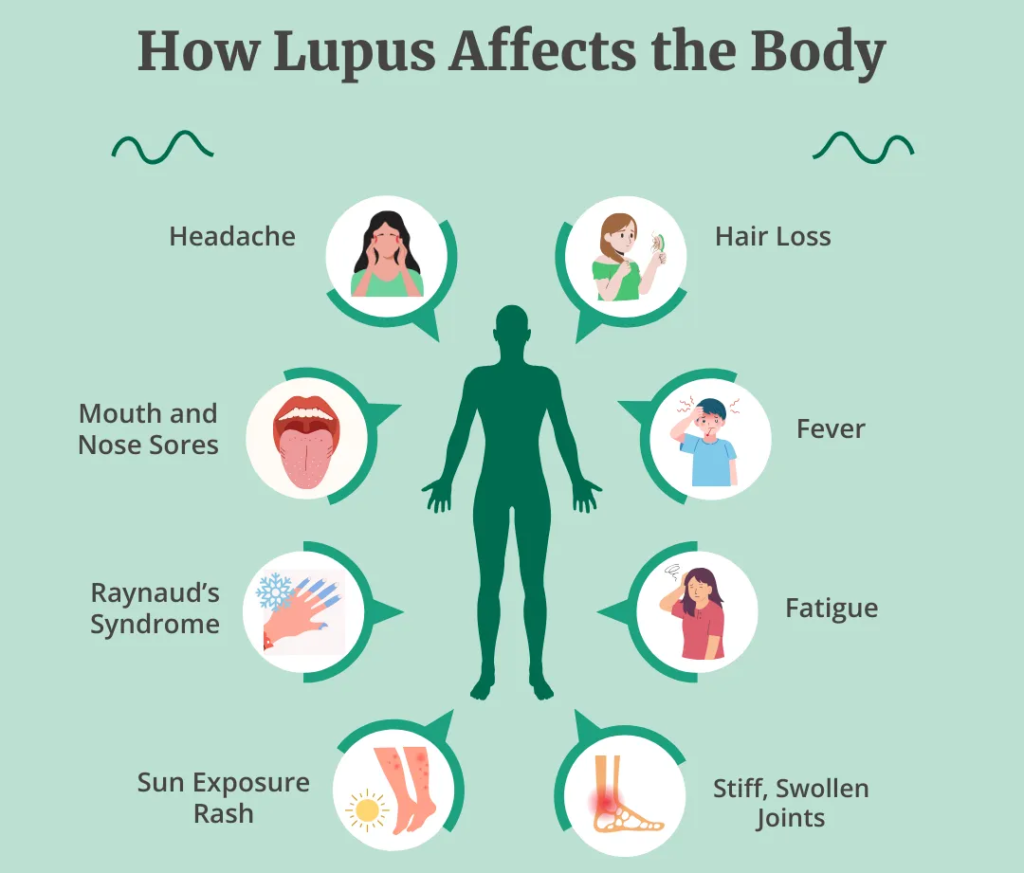
• Joint pain and swelling1,9
• Extreme, persistent fatigue1,9
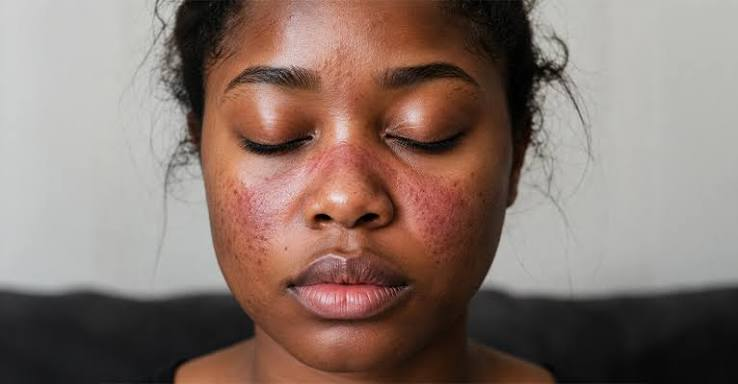
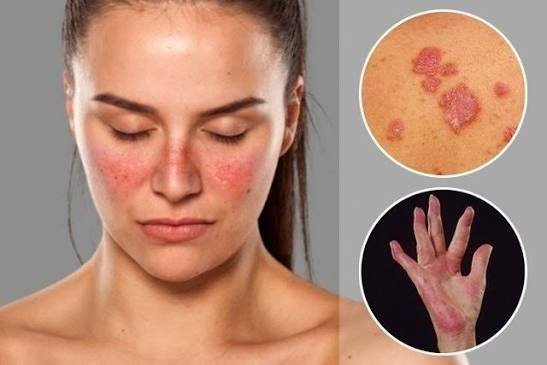
• Skin rashes especially a butterfly-shaped rash across the cheeks and nose, or rashes that worsen in sunlight1,9
• Unexplained hair loss
• Mouth ulcers
• Fever with no clear cause
• Swelling in the legs or around the eyes (can signal kidney involvement)
• Chest pain when breathing deeply
Why It’s Often Missed
• Lupus symptoms — joint pain, fatigue — overlap with many other conditions, which can delay diagnosis1
• Skin rashes can look different on darker skin and may be under-recognised by clinicians less familiar with how lupus presents on Black skin6
• Fatigue and joint pain are sometimes put down to stress or “pushing through,” which delays seeking help7
• Previous negative experiences with healthcare can understandably make some women hesitant to keep raising the same concern7
What You Can Do
• See a GP if you have persistent joint pain, unexplained fatigue, rashes (especially ones that worsen in sun), or repeated mouth ulcers1,9
• Describe clearly how a rash looks and behaves on your skin, and if lupus is suspected, ask your GP whether referral to rheumatology is appropriate.1
• Keep a simple diary of symptoms — what, when, how long, and what makes it better or worse
• If you have lupus, ask specifically about kidney function tests (urine and blood tests), given the higher risk of kidney involvement1,8
• Family and friends can help by noticing patterns — like fatigue that doesn’t lift, or repeated flare-ups — and encouraging a GP visit
What Good Care Should Look Like
• A clear route to see a rheumatologist if lupus is suspected1
• Regular monitoring of kidneys, blood counts and other organs1
• Being asked about symptoms in a way that takes pain and fatigue seriously
• A clear explanation of test results and treatment options1
• Ongoing follow-up care, not a one-off appointment1
Myths vs Facts
Myth: Lupus is rare, so it’s unlikely to be that.
Fact: It disproportionately affects Black women, and early diagnosis makes a real difference to long-term outcomes. 1,2
Myth: It’s just joint pain and tiredness.
Fact: Lupus can affect major organs, including the kidneys, and needs proper ongoing monitoring. 1,8
Myth: A normal-looking rash means it’s nothing serious.
Fact: Lupus rashes can look different across skin tones and are sometimes under-recognised — a persistent or sun-triggered rash should be medically assessed, particularly when it occurs with other symptoms suggestive of lupus.6
When to Seek Urgent Help
• Call 999 or go to A&E for severe difficulty breathing, severe or persistent chest pain, a new seizure, or sudden severe confusion.10–12
• Seek urgent medical advice for significant or rapidly increasing swelling, markedly reduced urine output, or blood in the urine.1,8
• If symptoms worsen and you are unsure how urgently you need help, contact NHS 111 for advice.9
Community Resources & Support
• Lupus UK information and regional support groups
• Faith-based and community wellbeing groups
• Peer support groups for people living with lupus
Final Takeaway
Lupus hits Black women harder and earlier. 1,2 Recognising the signs, describing symptoms clearly, and pushing for proper monitoring especially of the kidneys can protect long-term health. 1,8
References
1. Md Yusof MY, Smith EMD, Lythgoe H, et al. The 2026 British Society for Rheumatology guideline for the management of children, young people and adults with systemic lupus erythematosus. Rheumatology (Oxford). 2026;65(6):keag223. doi:10.1093/rheumatology/keag223.
2. Patel S, Russell MD, Bechman K, et al. The incidence, mortality and complications of systemic lupus erythematosus: a population-level cohort study from 2012 to 2023. Rheumatology (Oxford). 2026;65(5):keag206. doi:10.1093/rheumatology/keag206.
3. Rees F, Doherty M, Grainge MJ, Davenport G, Lanyon P, Zhang W. The incidence and prevalence of systemic lupus erythematosus in the UK, 1999-2012. Ann Rheum Dis. 2016;75(1):136-141. doi:10.1136/annrheumdis-2014-206334.
4. Izmirly PM, Wan I, Sahl S, et al. The incidence and prevalence of systemic lupus erythematosus in New York County (Manhattan), New York: the Manhattan Lupus Surveillance Program. Arthritis Rheumatol. 2017;69(10):2006-2017. doi:10.1002/art.40192.
5. Lim SS, Helmick CG, Bao G, et al. Racial disparities in mortality associated with systemic lupus erythematosus-Fulton and DeKalb Counties, Georgia, 2002-2016. MMWR Morb Mortal Wkly Rep. 2019;68(18):419-422. doi:10.15585/mmwr.mm6818a4.
6. Nozile W, Adgerson CN, Cohen GF. Cutaneous lupus erythematosus in skin of color. J Drugs Dermatol. 2015;14(4):343-349.
7. Hasan B, Fike A, Hasni S. Health disparities in systemic lupus erythematosus-a narrative review. Clin Rheumatol. 2022;41(11):3299-3311. doi:10.1007/s10067-022-06268-y.
8. Hanly JG, O’Keeffe AG, Su L, et al. The frequency and outcome of lupus nephritis: results from an international inception cohort study. Rheumatology (Oxford). 2016;55(2):252-262. doi:10.1093/rheumatology/kev311.
9. NHS. Lupus [Internet]. London: NHS; [cited 2026 Aug 9]. Available from: https://www.nhs.uk/conditions/lupus/
10. NHS. What to do if someone has a seizure (fit) [Internet]. London: NHS; [cited 2026 Aug 9]. Available from: https://www.nhs.uk/symptoms/what-to-do-if-someone-has-a-seizure-fit/
11. NHS. Sudden confusion (delirium) [Internet]. London: NHS; [cited 2026 Aug 9]. Available from: https://www.nhs.uk/symptoms/confusion/
12. NHS. Chest pain [Internet]. London: NHS; [cited 2026 Aug 9]. Available from: https://www.nhs.uk/symptoms/chest-pain/