


Written by Thelma Okunuga MPHARM on July 27th.

Reviewed by Dr. Tahir on August 28th.
Quick Summary
Anxiety disorders are common mental health conditions involving excessive fear, worry or anxiety that can interfere with daily life. UK evidence identifies inequalities in access to and experience of mental-health care affecting some Black groups, and qualitative research describes barriers including stigma, racism or discrimination, mistrust and care that may not feel culturally appropriate. However, evidence specifically quantifying anxiety underdiagnosis across every Black and African community is limited, so these experiences should not be treated as universal.[CFC30] [1-4]
Early recognition and appropriate support can improve wellbeing and quality of life.

What Are Anxiety Disorders?
Everyone experiences anxiety from time to time. Anxiety disorders are a group of conditions with different diagnostic criteria. For example, generalised anxiety disorder involves excessive worry that is difficult to control and affects everyday life, typically over a sustained period.[CFC31] Anxiety can affect mental and physical wellbeing and may interfere with work, relationships and daily activities. Effective treatments are available. [1,2]
Why This Matters for Black and African Communities
Mental-health experiences are not the same across all Black or African communities. Some UK evidence and qualitative work describe barriers to help-seeking and care that can include stigma, experiences of racism or discrimination, mistrust arising from previous healthcare experiences, financial or practical barriers, and care that does not feel culturally responsive. Some people also describe pressure to appear resilient or keep distress private, but this should not be presented as a universal cultural expectation.[CFC32] [3,4]
Improving awareness, trust and access to appropriate care may help more people seek support when needed.
Common Signs and Symptoms
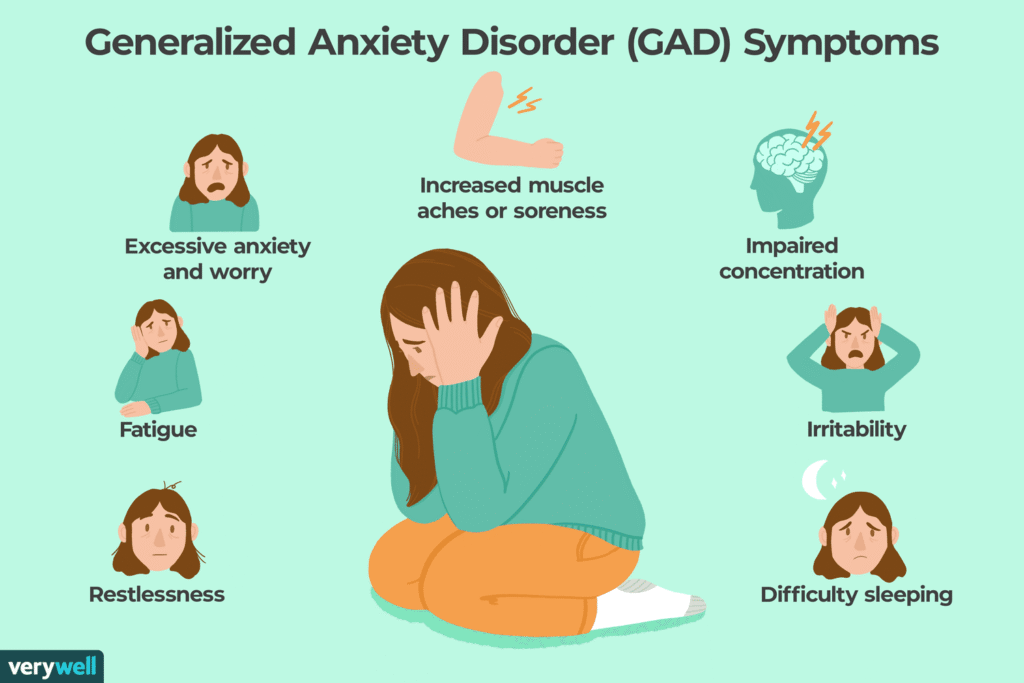
Depending on the anxiety disorder, symptoms can include:
· Excessive or persistent worry
· Feeling on edge or restless
· Difficulty relaxing
· Trouble sleeping
· Poor concentration
· Irritability
· Fast heartbeat, sweating or trembling
· Stomach discomfort
· Avoiding situations because of fear or worry
· Feelings of breathlessness or chest tightness
These physical symptoms are not specific to anxiety. New, severe or unexplained chest pain, breathing difficulty or other concerning physical symptoms should be medically assessed rather than assumed to be anxiety.[CFC33] [1]
Why It Is Often Missed
Anxiety can be mistaken for everyday stress, and people may delay seeking help if they expect symptoms to pass. Physical illness can also mimic anxiety and vice versa. For some Black people, stigma, previous experiences of discrimination or mistrust and practical barriers to accessing mental-health services may affect help-seeking; the importance of these factors varies between individuals and communities.[CFC34] [3,4]
What You Can Do
If anxiety is affecting your daily life, speak with your GP or another healthcare professional. Keeping a diary of symptoms and triggers may help you describe what is happening. NICE-recommended treatment depends on the diagnosis, severity and individual preference and can include evidence-based self-help, cognitive behavioural therapy or other psychological treatment, and medication such as an SSRI when appropriate.[CFC35] [2]
In many areas of England, adults can also self-refer to NHS Talking Therapies without first seeing a GP.[CFC36] [3]
Myths vs Facts
Myth: Anxiety is a sign of weakness.
Fact: Anxiety disorders are recognised mental-health conditions that can affect anyone.
Myth: Strong people do not experience anxiety.
Fact: Anxiety can affect people who see themselves as resilient or strong, and seeking evidence-based support can be an appropriate response.
Final Takeaway
Anxiety disorders are common and treatable. Black and African communities are diverse, so barriers to care should be explored rather than assumed. If persistent anxiety is affecting daily life, evidence-based psychological treatment, self-help and medication options are available through NHS services.[CFC37]
Verified references
1. NHS. Generalised anxiety disorder in adults. Current NHS Health A-Z guidance.
2. NICE. Generalised anxiety disorder and panic disorder in adults: management (CG113). https://www.nice.org.uk/guidance/cg113
3. NHS England. NHS Talking Therapies for anxiety and depression.
4. Mental Health Foundation. Black mental health and inequalities resources (2025): useful for qualitative context on racism, stigma and culturally appropriate care, but not proof of anxiety-specific underdiagnosis in every Black/African group.